What it involves
Abdominal phalloplasty uses skin and fatty tissue from the lower belly to create a penis, also called a phallus. The tissue remains attached to the body at its base.
The first operation creates the phallus from lower abdominal tissue. It takes about two and a half hours and usually involves approximately four days in hospital. These estimates apply to the first stage; later operations have their own recovery plans.
Begin with your goals. Appearance, sensation, urination, sexual function and the demands of recovery are all useful topics for a consultation. You do not need to have every answer before you meet the team.
How the tissue is reshaped
The illustration follows tissue from the lower abdomen as it is shaped into a phallus and the abdomen is closed. It shows a surgical concept, rather than an individual patient’s result.
View the surgical illustration
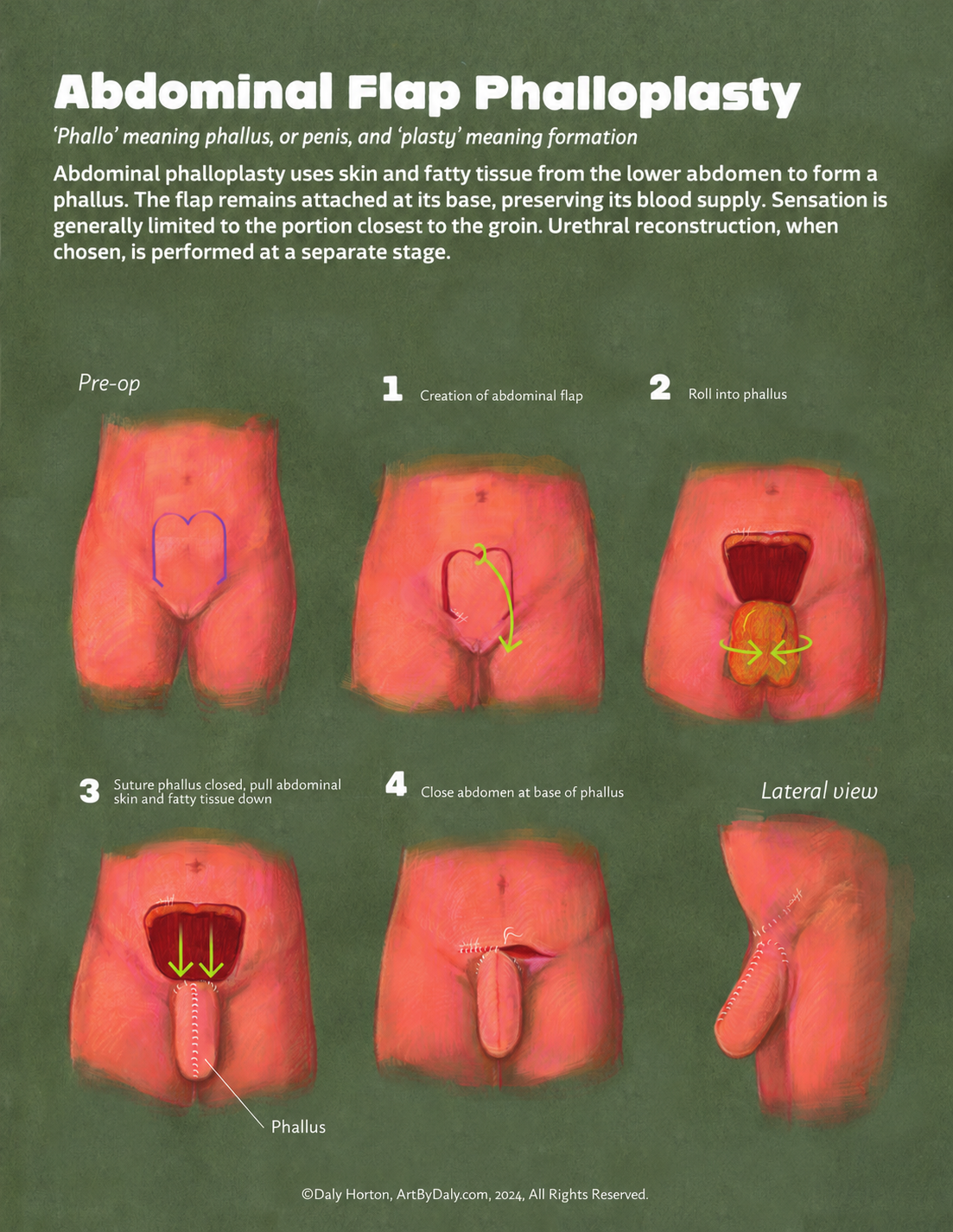
Read the illustration description
A flap is outlined on the lower abdomen. The tissue is raised while remaining attached at its base, then rolled and sutured to form the phallus. The surrounding abdominal skin is brought down and closed. The final panel shows a side view.
Surgical stages
If the flap needs to be delayed, use the operation that successfully creates the phallus as the starting point for the timeline below.
The pathway depends on whether you want urethral lengthening so that urine can pass through the tip of the penis. The usual plan spaces each operation about six months apart. These are planning estimates; your team will confirm timing for your recovery.
Without urethral lengthening
Three operations over about 12 months if you choose to proceed through the implant stage.
- Stage 1 — initial operation: create the phallus from lower abdominal tissue.
- Stage 2 — about 6 months after the first operation: perform vaginectomy and vaginal closure, create the scrotum (scrotoplasty), masculinize the perineum, shape the head of the penis (glansplasty), and create a perineal urethrostomy—a urinary opening in the perineum rather than at the tip of the penis.
- Stage 3 — about 12 months after the first operation: placement of a penile prosthesis and testicular prostheses, if desired and included in your plan.
With urethral lengthening
Four operations over about 18 months if you choose to proceed through the implant stage. This pathway adds a separate urethral-construction operation, labeled Stage 1B here.
- Stage 1 — initial operation: create the phallus from lower abdominal tissue.
- Stage 1B — about 6 months after the first operation: perform radial artery urethroplasty. Tissue from the forearm is shaped into a urethra and placed inside the abdominal phallus. This operation creates the urinary channel; connection to your existing urethra happens at the next stage.
- Stage 2 — about 12 months after the first operation: connect the urethra inside the phallus to your existing urethra. This operation also includes vaginectomy and vaginal closure, scrotoplasty and glansplasty. A gracilis muscle flap from the left inner thigh supports the urethral closure.
- Stage 3 — about 18 months after the first operation: placement of a penile prosthesis and testicular prostheses, if desired and included in your plan.
Stage 2 follows the same operative pathway as stage 2 after radial forearm phalloplasty: approximately four hours of surgery and a one- or two-night hospital stay.
In this pathway, forearm tissue is used to make the urinary channel inside an abdominal phallus. This differs from radial forearm phalloplasty, where forearm tissue is used to create the phallus itself.
Discuss the components of your plan with the team. Urethral reconstruction is intended to allow urination through the tip, but the outcome and any need for additional surgery depend on your individual course.
Choices to discuss with your surgeon
Abdominal and radial forearm phalloplasty are the two phalloplasty approaches currently offered by this practice. The right discussion depends on your goals, anatomy and surgical history.
Urination and the urinary channel
Decide with your team whether urethral lengthening fits your goals. Creating the phallus alone does not establish urination through its tip. Urethral construction and connection require the additional stages described above.
Sensation and sexual goals
Sensation is generally limited to the part of the phallus nearest the groin. Review the sensation section below and discuss what this means for your sexual goals.
Other procedures and stages
Ask about the role of scrotoplasty, glansplasty, urethral reconstruction and implants in your own plan. A diagram of one approach does not mean that every component is required.
Alternatives and timing
Ask how abdominal phalloplasty compares with radial forearm phalloplasty and other options that may fit your goals. Taking more time or deciding not to have surgery is also an option.
Sensation
Sensation after abdominal phalloplasty is limited. It is generally present in the proximal portion—the part nearest the groin. The distal half, toward the tip, typically does not have sensation.
If the pathway includes radial artery urethroplasty, the forearm tissue used inside the phallus can provide some internal sensation. That sensation does not necessarily extend to the outer surface of the phallus.
Wound healing and flap delay
These approximate counseling estimates reflect a combination of published literature and Dr. Gupta’s clinical experience. They are not measured outcomes from a single practice cohort or guarantees of an individual result.
Wound-healing problems
Minor healing problems occur in many patients. Dr. Gupta estimates that significant wound-healing problems or wound separation occur in about 20% of patients. Some can be managed with local wound care; others may require additional surgery.
When the flap needs to be delayed
During the initial operation, the team raises the abdominal flap and shapes it into a phallus. ICG angiography is used to assess its blood supply. If the blood supply is not adequate, the flap is returned to the abdomen. The team returns about six weeks later to raise and shape it again. This is called a flap delay.
Dr. Gupta estimates that flap delay is needed in about 20% of patients. The examination at the preoperative visit often helps the team estimate whether this may be needed. It adds an operation to the usual staged pathway.
If a flap delay is needed, the six-month interval to the next operation is counted from successful creation of the phallus, not the initial operation when the flap was returned to the abdomen.
Flap delay and wound-healing problems are different events; these percentages should not be added together.
Penile implants
A penile implant can provide rigidity after phalloplasty. Choosing a device depends on your anatomy, goals and ability to use it. Dr. Gupta offers inflatable and malleable implants from Coloplast and Boston Scientific and reports good experience with both types.
Inflatable or malleable
An inflatable implant is less prominent when deflated and, in Dr. Gupta’s counseling, produces a more natural erection. You must be able to operate the pump, and the reconstructed scrotum must have enough room to hold it. Hand dexterity and your ability to reach and use the pump are part of the assessment. Its fluid-filled components can develop hydraulic problems or leaks.
A malleable implant can be positioned without inflating or deflating a pump and does not have the same hydraulic components. Dr. Gupta does not regard a higher rate of tip erosion with malleable implants as established. A major concern is detachment from the pubic bone; this can also occur with an inflatable device.
Choosing a manufacturer
Device selection depends on anatomy as well as preference. Published retrospective studies have reported differences between devices. Dr. Gupta has had good results with both manufacturers; anatomy and individual needs guide his selection. This does not establish comparative equivalence.
He values the antibiotic surface treatment available on Boston Scientific’s AMS 700 inflatable implant. This is a model-specific feature, not a feature of every device from that company. Manufacturer information about AMS 700 →
Placement after phalloplasty
In Dr. Gupta’s technique, an inflatable implant uses one cylinder rather than the two typically used in a native penis.
Revision and replacement
Plan for the possibility of further implant surgery over your lifetime. Dr. Gupta counsels that about 50% of implants after phalloplasty require revision or replacement within approximately three years. Reasons include mechanical failure, infection, erosion or impending erosion through tissue, detachment at the base, and difficulty using the device. This is an estimate for revision or replacement for any of these reasons, not a mechanical-failure rate alone.
Infection
Infection is a particularly concerning complication. Dr. Gupta’s approximate counseling estimate is less than 2% within the first 30 days after implantation. This does not describe the risk over the device’s entire lifetime.
If an implant becomes infected, his described treatment is removal, followed by a period of healing before considering another implant, usually several months later. The team determines the timing for each patient.
These are Dr. Gupta’s October 2026 counseling estimates and practice descriptions, not independently audited website outcomes. These figures concern penile implants, not testicular implants.
Recovery after penile implant placement
Penile implant placement, with or without testicular implants at the same operation, takes approximately two hours and is an outpatient procedure. A drain is usually left in place. Plan to stay in the area for about one week: Dr. Gupta sees you in clinic between postoperative days five and seven and removes the drain. You can then return home if needed.
A further visit is required four weeks after surgery to assess healing. For an inflatable device, Dr. Gupta begins cycling the implant at that visit and teaches you how to use it. The usual subsequent instruction is to inflate it daily for about 10 minutes; follow the technique and schedule taught by your team.
Sexual activity using the implant: wait until three months after surgery. This applies to both inflatable and malleable penile implants. Beginning inflatable-device cycling at four weeks does not mean the implant is ready for sexual activity.
Testicular implants
Dr. Gupta uses Coloplast Torosa testicular implants: a silicone shell filled with saline. Solid implants are another type, but are not used in this practice. Torosa comes in several sizes; the surgeon selects the size during the operation to fit the reconstructed scrotum. Torosa manufacturer information →
One or two implants
With an inflatable penile implant, the pump occupies one side of the reconstructed scrotum, so Dr. Gupta typically places one testicular implant. With a malleable penile implant, he typically places two testicular implants.
Discomfort and repositioning
An implant can move too high toward the groin canal or press against the pubic bone, causing discomfort. Repositioning may be needed. Dr. Gupta’s approximate counseling estimate for repositioning is 2–3%; no specific follow-up period is assigned to this estimate.
Infection and erosion
Infection and erosion through the surrounding tissue can occur, but Dr. Gupta describes these as uncommon for the testicular implants themselves. No numerical estimate is assigned. The 2–3% repositioning estimate is not an infection, erosion or overall complication rate.
These are Dr. Gupta’s October 2026 practice descriptions and counseling estimates, not independently audited website outcomes. Manufacturer information supports device description and sizing, not these outcome estimates. Penile implant revision and infection figures should not be applied to testicular implants.
Testicular implants alone
When testicular implants are placed without a penile implant at the same operation, surgery takes approximately 30 minutes. No drain is used, and you go home the same day. Routine follow-up is approximately four weeks later.
Plan for time, travel and support
Hair removal for the forearm urethral graft
If your plan includes radial artery urethroplasty, the entire volar surface of the forearm—the front or palm-facing side—must be hair-free. Complete hair removal at least six weeks before the radial artery urethroplasty operation. This requirement applies to the forearm urethral-graft procedure, not automatically to every abdominal phalloplasty.
Local stay and flying
Local stay depends on the operation. After stage 2 without urethral join-up, plan for about two weeks locally. After stage 2 with join-up, remain until all catheters are removed, usually about four weeks. Penile implant placement has its own local-stay and follow-up schedule, described above.
For other phalloplasty stages, the general local-stay planning estimate is about two weeks; confirm your specific plan with the team. Flying is generally restricted for two to four weeks. Ask your care team when you can fly; some patients may be able to fly earlier. Flight clearance does not replace the local stay needed for follow-up and catheter removal.
These are planning ranges for abdominal and radial forearm phalloplasty. Confirm the timing for your operation and recovery with the team before finalizing travel.
Before your consultation
- Write down what you hope surgery will help you achieve.
- Bring questions about prior surgery, medications and your health history.
- Think about who could help with travel and day-to-day needs during recovery.
- Ask which preparation steps apply to your procedure and stage.
Current program preparation requirements
For the adult genital-surgery pathway discussed here, the program requires age 19 or older, two support letters from two different mental health professionals, and 12 continuous months of hormone therapy.
The program’s nicotine-free interval is three months before surgery and six months afterward. This includes nicotine patches, gum and lozenges. Ask the team about any circumstances that may affect your preparation plan.
Confirm how these requirements apply to your planned procedure. Program requirements and insurance coverage requirements are separate questions.
Recovery and follow-up
After radial artery urethroplasty (Stage 1B)
This operation takes approximately five hours. The hospital stay is about five days for flap monitoring, including two days in the ICU, two days of bed rest and approximately one day without food or drink. The forearm donor site receives a skin graft during the same operation.
Overall recovery is approximately one month to six weeks. A temporary catheter acts as a stent inside the newly created urethra for about one week, then the team removes it. It does not extend into the bladder: the new urethra is not yet connected to your existing urinary passage.
A few weeks after surgery, the team teaches you how to flush the new urethra. After this teaching, flush it twice a week as instructed until the urethral join-up operation, planned about six months later. Your team supplies the technique and materials; this page does not replace that instruction.
After stage 2 with urethral join-up
Overall recovery from stage 2 is about two months. Plan to stay locally until all catheters have been removed, usually about four weeks after surgery. Your team confirms removal and return-home timing based on healing.
The operation and postoperative drain and catheter plan are the same as stage 2 after radial forearm phalloplasty. The gracilis muscle is harvested from the left inner thigh. You go home with a drain in the muscle-harvest site and a drain in the perineum, a urethral catheter passing through the tip of the penis into the bladder, and a suprapubic tube.
- Leg and perineal drains: removed after about one week.
- Urethral catheter: removed approximately three weeks after surgery.
- Suprapubic tube: removed approximately four weeks after surgery.
After stage 2 without urethral join-up
Overall recovery from stage 2 is about two months. Plan to stay locally for about two weeks after surgery, even though the catheter through the perineal urethrostomy is usually removed at about one week. The team confirms when you can return home.
This operation includes vaginectomy and vaginal closure, scrotoplasty, perineal masculinization, glansplasty and a perineal urethrostomy. No gracilis muscle flap is harvested.
- Perineal drain: removed approximately five days to one week after surgery.
- Urinary catheter: passes through the perineal urethrostomy into the bladder and is removed approximately one week after surgery.
- Suprapubic tube: not routinely required.
Your team assesses healing and arranges catheter and drain removal. These are expected follow-up milestones, not instructions to remove them yourself.
At your preoperative visit, your care team will explain who to contact during and after office hours, which symptoms need an immediate call, and when to seek emergency care.
Your team will provide instructions for your operation and stage of recovery. Use your discharge instructions for wound care, activity, follow-up and when to contact the team.
- What help will I need with daily activities?
- When should I return for follow-up?
- When can I return to work, exercise and other activities?
Your consultation questions
Select the questions you want to bring. Add your own, then print or save your list as a PDF using your browser. Your selections stay in this page and reset when you reload it.
My questions for consultation
Abdominal phalloplasty · Gupta Urology education · October 2026
Discussion aid; follow your care team’s individual instructions.
Select a topic above or write a question to begin your list.
Sources and review
Selected clinical references
These studies provide context. The figures attributed to Dr. Gupta are his counseling estimates, not numbers calculated from this reference list. Published techniques, patient groups and follow-up periods differ.
- Wang et al., 2026 — outcomes by phalloplasty flap choice. Includes pedicled abdominal reconstruction; techniques, case mix and outcome definitions differ.
- Lee et al., 2026 — long-term inflatable implant revision. Retrospective implant data; mechanical failure and revision for any reason are different endpoints.
- Gobbo et al., 2026 — inflatable implant outcomes and experience. Five-year outcomes; this does not directly validate the three-year counseling estimate.
Appointments and clinical questions
For appointments and patient-specific questions, contact the University Hospitals gender-care service.
Connect with the care team ↗Sources: supplied program materials, Daly Horton’s abdominal phalloplasty poster (2024), and Dr. Gupta’s clinical clarifications through October 11, 2026.