What it involves
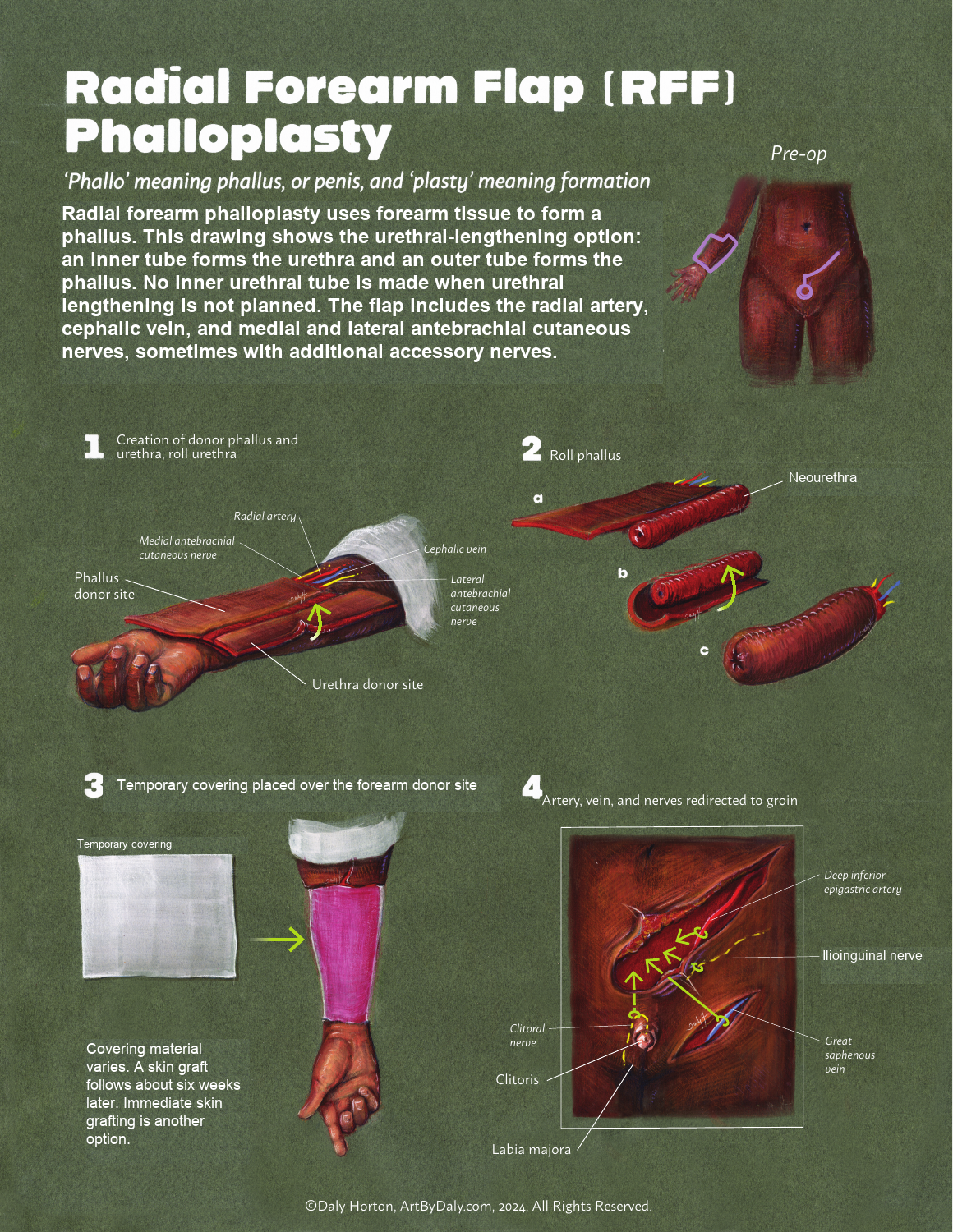
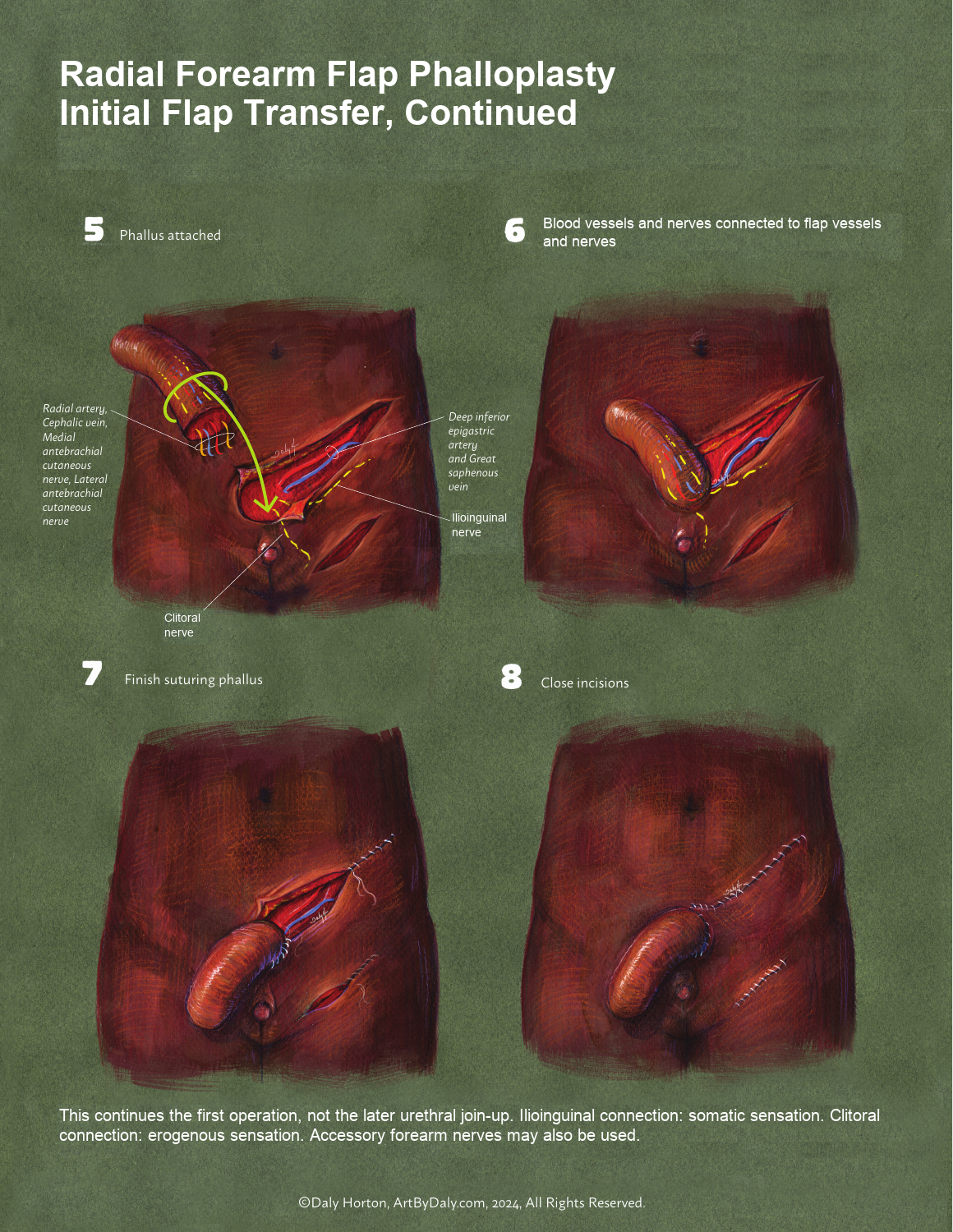
Radial forearm phalloplasty uses a flap of tissue from the forearm to create a penis. The flap is moved to the groin, where its blood vessels and nerves are connected to recipient vessels and nerves.
When urethral lengthening is planned, the flap is shaped using a “tube within a tube” technique. The inner tube is the urethra within the phallus, also called the pendulous urethra. The outer tube forms the phallus. The new urethra is not connected to your existing urethra during this first operation.
If you choose not to have urethral lengthening, no pendulous urethra is created. The three main stages follow the same timing, with a different urinary procedure at stage 2.
The forearm donor site
The donor site is the area of the forearm from which tissue is taken. Your team assesses the arm’s blood supply and considers scars, previous surgery and how you use your hands.
You and the plastic surgery team will discuss two options for covering this area:
- Immediate skin graft: a split-thickness skin graft is placed at the first operation.
- Delayed skin graft: a dermal substitute or other temporary covering is placed initially, followed by a skin graft about six weeks later. The covering material varies; you and the plastic surgery team will discuss the choice. This adds a donor-site procedure between the main stages.
The advantages, disadvantages and care requirements of each option are discussed during consultation with the plastic surgery team.
Hair removal
The entire volar surface of the forearm—the front or palm-facing side—must be hair-free. The same treatment area applies when forearm tissue is used for radial artery urethroplasty within an abdominal phalloplasty pathway. For both procedures, complete hair removal at least six weeks before the operation that uses the forearm tissue.
Illustrated explanation
The first poster shows the flap being shaped and moved to the groin. The second shows connections and closure. These are surgical schematics, not patient results.
View flap construction and transfer
View connections and closure
Stages and choices
The usual plan has three main stages, with about six months between them. If you choose delayed donor-site skin grafting, that procedure occurs about six weeks after stage 1. Your team confirms the schedule based on healing.
Stage 1 — initial operation
Dr. Gupta and a plastic surgeon work together to create the phallus, transfer the flap and connect its blood vessels and nerves. Clitoral burial is performed at the same operation.
- Operating time: approximately eight hours.
- Hospital stay: approximately five to six days, including the first two nights in the ICU.
- For about the first 24 hours after surgery, nothing is taken by mouth—no food or drink—as directed by the inpatient team.
- Bed rest lasts about 48 hours after surgery.
At this stage, the phallus has not yet had its head shaped by glansplasty. Even when a pendulous urethra has been created, you cannot yet urinate through the tip because it has not been connected to your existing urethra.
Stage 2 — about six months after stage 1
Dr. Gupta performs vaginectomy and vaginal closure, scrotoplasty to create the scrotum, and glansplasty to shape the head of the penis. The urinary reconstruction depends on your plan:
- With urethral lengthening: the pendulous urethra is connected to your existing urethra. A gracilis muscle flap from the left inner thigh is used to support the urethral closure.
- Without urethral lengthening: perineal masculinization and a perineal urethrostomy are performed—a urinary opening in the perineum, rather than through the tip of the penis. The gracilis muscle flap is not harvested for this pathway.
This operation takes approximately four hours and usually involves a one- or two-night hospital stay.
Once healed, the phallus has a shaped head and a scrotum has been created. Testicular implants have not yet been placed. When urethral join-up has healed successfully, the intended function is urination through the tip of the penis.
Stage 3 — about six months after stage 2
Penile and testicular implants can be placed once you are fully healed, if they are part of your plan. This is approximately one year after the first operation.
Surgical terms and related procedures →Expected function
These approximate counseling estimates reflect a combination of published literature and Dr. Gupta’s clinical experience. They are not measured outcomes from a single practice cohort or guarantees of an individual result.
Urination
For patients pursuing urethral lengthening who complete all planned stages, Dr. Gupta estimates about a 90% chance of being able to urinate through the tip of the penis. This does not mean that the entire course is free of urinary complications or additional operations.
Sensation
Dr. Gupta estimates about an 80% chance of sensation in the phallus. Sensation may be patchy rather than evenly distributed. Recovery can take up to two years to fully mature.
Dr. Gupta connects flap nerves to the ilioinguinal nerve for somatic sensation—feeling touch—and to the clitoral nerve for erogenous sensation associated with sexual pleasure. The degree and distribution of sensation vary; the estimate is not a guarantee of either type of sensation for every patient.
Penile implants and sexual activity
Most patients who receive a penile implant can use the device to produce an erection. That does not necessarily mean they can or will use it for sexual activity. Device comfort, personal circumstances, partner factors and other considerations also matter.
Complications and additional surgery
Dr. Gupta counsels patients to expect some complication or healing problem during the course of phalloplasty. Many are wound-related, including separation of the incision (dehiscence), delayed healing and granulation tissue. These range from problems managed with wound care to problems requiring another operation.
- Total flap loss: about 3%. The entire transferred flap can be lost. This is a major complication.
- Partial tissue loss: about 10%. Areas of the flap may not survive. Removing nonviable tissue (debridement) or further surgery may be needed.
- Urethral complications: about 25–40%. Problems such as narrowing of the urinary channel (stricture) or an unwanted opening that leaks urine (fistula) may require additional surgery.
These categories may overlap and should not be added together. Discuss which risks apply to your planned urinary reconstruction.
Penile implants
A penile implant can provide rigidity after phalloplasty. Choosing a device depends on your anatomy, goals and ability to use it. Dr. Gupta offers inflatable and malleable implants from Coloplast and Boston Scientific and reports good experience with both types.
Inflatable or malleable
An inflatable implant is less prominent when deflated and, in Dr. Gupta’s counseling, produces a more natural erection. You must be able to operate the pump, and the reconstructed scrotum must have enough room to hold it. Hand dexterity and your ability to reach and use the pump are part of the assessment. Its fluid-filled components can develop hydraulic problems or leaks.
A malleable implant can be positioned without inflating or deflating a pump and does not have the same hydraulic components. Dr. Gupta does not regard a higher rate of tip erosion with malleable implants as established. A major concern is detachment from the pubic bone; this can also occur with an inflatable device.
Choosing a manufacturer
Device selection depends on anatomy as well as preference. Published retrospective studies have reported differences between devices. Dr. Gupta has had good results with both manufacturers; anatomy and individual needs guide his selection. This does not establish comparative equivalence.
He values the antibiotic surface treatment available on Boston Scientific’s AMS 700 inflatable implant. This is a model-specific feature, not a feature of every device from that company. Manufacturer information about AMS 700 →
Placement after phalloplasty
In Dr. Gupta’s technique, an inflatable implant uses one cylinder rather than the two typically used in a native penis.
Revision and replacement
Plan for the possibility of further implant surgery over your lifetime. Dr. Gupta counsels that about 50% of implants after phalloplasty require revision or replacement within approximately three years. Reasons include mechanical failure, infection, erosion or impending erosion through tissue, detachment at the base, and difficulty using the device. This is an estimate for revision or replacement for any of these reasons, not a mechanical-failure rate alone.
Infection
Infection is a particularly concerning complication. Dr. Gupta’s approximate counseling estimate is less than 2% within the first 30 days after implantation. This does not describe the risk over the device’s entire lifetime.
If an implant becomes infected, his described treatment is removal, followed by a period of healing before considering another implant, usually several months later. The team determines the timing for each patient.
These are Dr. Gupta’s October 2026 counseling estimates and practice descriptions, not independently audited website outcomes. These figures concern penile implants, not testicular implants.
Recovery after penile implant placement
Penile implant placement, with or without testicular implants at the same operation, takes approximately two hours and is an outpatient procedure. A drain is usually left in place. Plan to stay in the area for about one week: Dr. Gupta sees you in clinic between postoperative days five and seven and removes the drain. You can then return home if needed.
A further visit is required four weeks after surgery to assess healing. For an inflatable device, Dr. Gupta begins cycling the implant at that visit and teaches you how to use it. The usual subsequent instruction is to inflate it daily for about 10 minutes; follow the technique and schedule taught by your team.
Sexual activity using the implant: wait until three months after surgery. This applies to both inflatable and malleable penile implants. Beginning inflatable-device cycling at four weeks does not mean the implant is ready for sexual activity.
Testicular implants
Dr. Gupta uses Coloplast Torosa testicular implants: a silicone shell filled with saline. Solid implants are another type, but are not used in this practice. Torosa comes in several sizes; the surgeon selects the size during the operation to fit the reconstructed scrotum. Torosa manufacturer information →
One or two implants
With an inflatable penile implant, the pump occupies one side of the reconstructed scrotum, so Dr. Gupta typically places one testicular implant. With a malleable penile implant, he typically places two testicular implants.
Discomfort and repositioning
An implant can move too high toward the groin canal or press against the pubic bone, causing discomfort. Repositioning may be needed. Dr. Gupta’s approximate counseling estimate for repositioning is 2–3%; no specific follow-up period is assigned to this estimate.
Infection and erosion
Infection and erosion through the surrounding tissue can occur, but Dr. Gupta describes these as uncommon for the testicular implants themselves. No numerical estimate is assigned. The 2–3% repositioning estimate is not an infection, erosion or overall complication rate.
These are Dr. Gupta’s October 2026 practice descriptions and counseling estimates, not independently audited website outcomes. Manufacturer information supports device description and sizing, not these outcome estimates. Penile implant revision and infection figures should not be applied to testicular implants.
Testicular implants alone
When testicular implants are placed without a penile implant at the same operation, surgery takes approximately 30 minutes. No drain is used, and you go home the same day. Routine follow-up is approximately four weeks later.
Preparation and travel
Review your health history, prior operations, medications and goals with the team. Ask which steps need to be completed before a surgical date can be confirmed.
Consultation and preparation guide →Local stay and flying
Local stay depends on the operation. After stage 2 without urethral join-up, plan for about two weeks locally. After stage 2 with join-up, remain until all catheters are removed, usually about four weeks. Penile implant placement has its own local-stay and follow-up schedule, described above.
For other phalloplasty stages, the general local-stay planning estimate is about two weeks; confirm your specific plan with the team. Flying is generally restricted for two to four weeks. Ask your care team when you can fly; some patients may be able to fly earlier. Flight clearance does not replace the local stay needed for follow-up and catheter removal.
These planning ranges apply to abdominal and radial forearm phalloplasty. Confirm the timing for your operation and recovery before finalizing travel.
Recovery and follow-up
At your preoperative visit, your care team will explain who to contact during and after office hours, which symptoms need an immediate call, and when to seek emergency care.
After stage 1
Recovery takes about two months. At discharge, usually on day five or six, you receive instructions for activity restrictions, supporting the phallus in the prescribed position, and dressings. Follow your team’s specific instructions for the angle, support and wound care.
After stage 2 with urethral join-up
Overall recovery from stage 2 is about two months. Plan to stay locally until all catheters have been removed, usually about four weeks after surgery. Your team confirms removal and return-home timing based on healing.
You go home with a drain in the left thigh muscle-harvest site, a perineal drain, a urethral catheter passing through the tip of the penis into the bladder, and a suprapubic tube. The usual removal milestones, measured from the stage 2 operation, are:
- Drains: about one week.
- Urethral catheter: about three weeks.
- Suprapubic tube: about four weeks.
Your team assesses healing and arranges removal. These are expected follow-up milestones, not instructions to remove a catheter or drain yourself.
After stage 2 without urethral lengthening
Overall recovery from stage 2 is about two months. Plan to stay locally for about two weeks after surgery, even though the catheter through the perineal urethrostomy is usually removed at about one week. The team confirms when you can return home.
No gracilis muscle flap is harvested. The usual drain and catheter plan is:
- Perineal drain: removed approximately five days to one week after surgery.
- Urinary catheter: passes through the perineal urethrostomy into the bladder and is removed approximately one week after surgery.
- Suprapubic tube: not routinely required for this pathway.
Your team confirms removal timing based on healing and arranges removal.
Recovery planning →Questions for consultation
Select the questions you want to bring and add your own. Your list stays in this page and resets when you reload it.
My consultation questions
Radial forearm phalloplasty · Gupta Urology education · October 2026
Educational information; not an individual care plan.
Select a question or add your own.
Sources and review
Based on supplied University Hospitals program handouts and Daly Horton’s educational illustrations (2024), with Dr. Gupta’s October 2026 clarifications. The handouts describe particular techniques and pathways; they are not a substitute for your individual instructions.
University Hospitals gender-affirmation surgery service ↗
Appointments and clinical questions ↗Selected clinical references
These studies provide context. The figures attributed to Dr. Gupta are his counseling estimates, not numbers calculated from this reference list. Published techniques, patient groups and follow-up periods differ.
- Ascha et al., 2018 — single-stage phalloplasty outcomes. A different operative sequence; provides context for urethral complications, not validation of this program’s exact estimates.
- Hu et al., 2024 — prospective sensory testing after radial forearm phalloplasty. A small pilot study of early sensory recovery; it does not establish an 80% long-term success rate.
- Lee et al., 2026 — long-term inflatable implant revision. Retrospective implant data; mechanical failure and revision for any reason are different endpoints.
- Gobbo et al., 2026 — inflatable implant outcomes and experience. Five-year outcomes; this does not directly validate the three-year counseling estimate.