What it involves
There are options with and without a vaginal canal. Vaginoplasty with a canal creates the vaginal canal and external structures. Surgery without a canal is called zero-depth vaginoplasty or vulvoplasty.
This guide covers surgery with a canal. The practice offers penile-inversion and robotic-assisted peritoneal vaginoplasty for primary reconstruction. Colovaginoplasty is offered only for revision cases.
Read about zero-depth vaginoplasty (vulvoplasty) →Surgical approaches
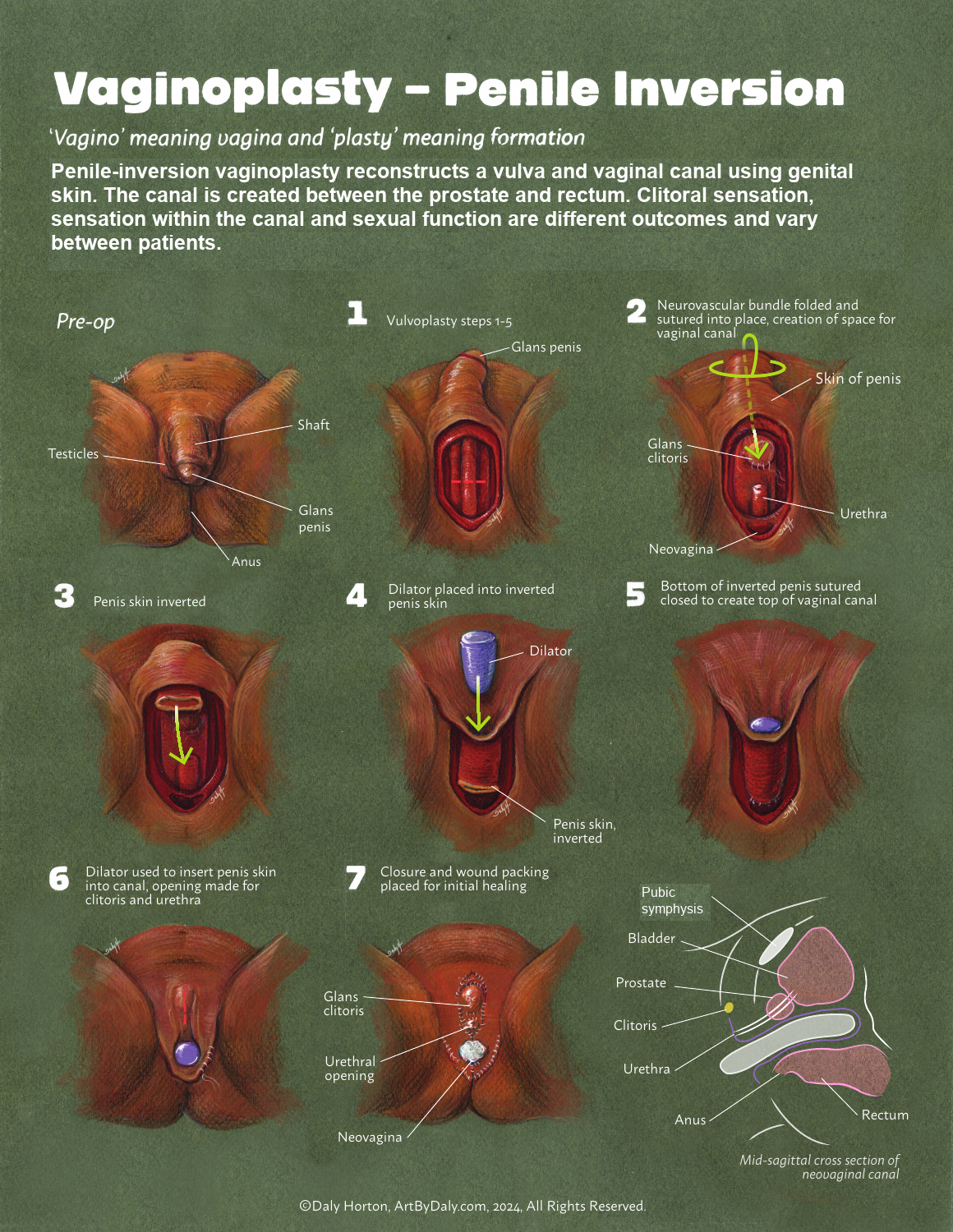
Penile-inversion vaginoplasty
Skin from the penis is used to line the canal. Additional tissue may be used depending on the surgical plan. Hair removal is mandatory and must be completed at least six weeks before surgery. Confirm the treatment areas with the surgical team.
Robotic-assisted peritoneal vaginoplasty
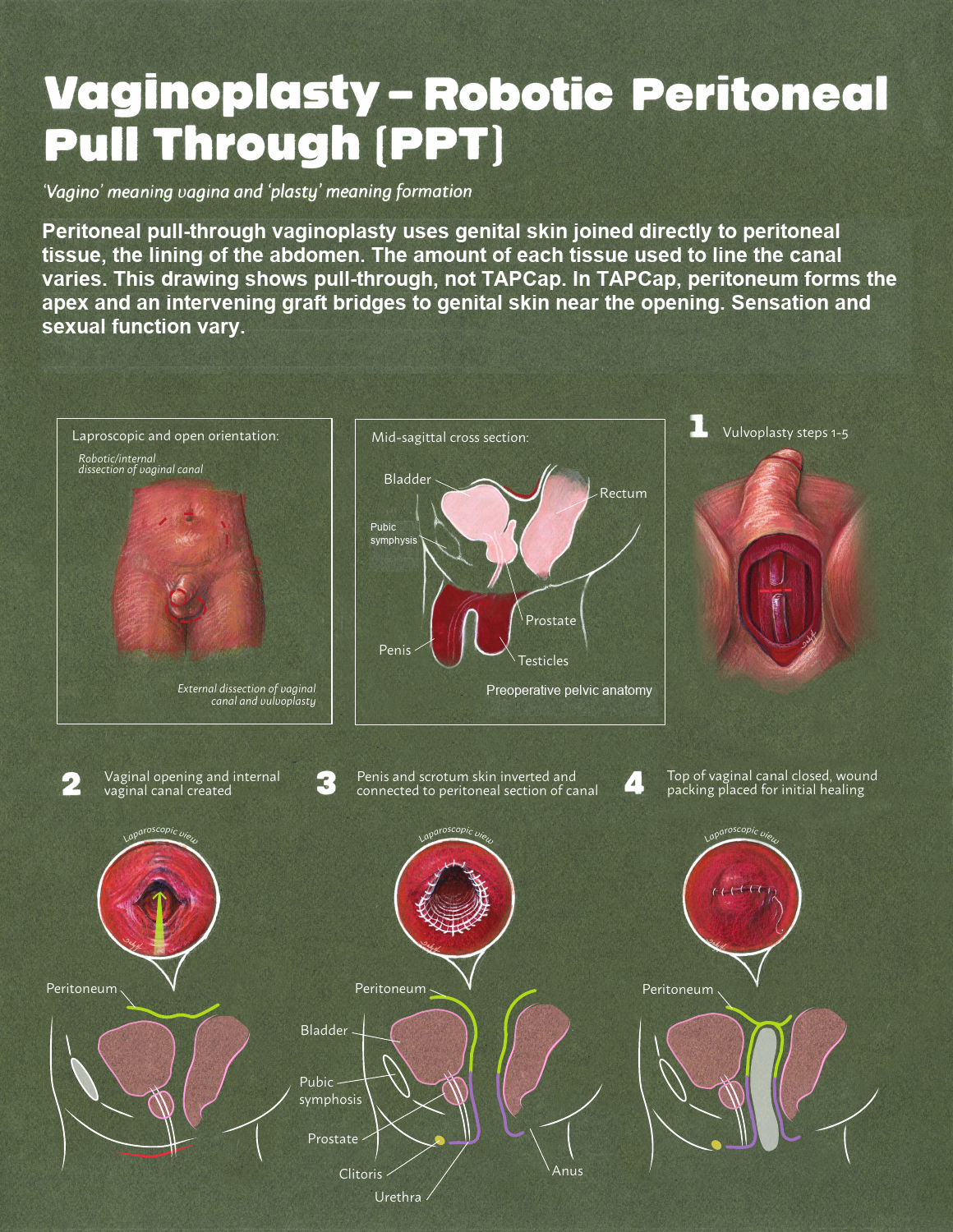
This approach uses peritoneal tissue—the lining of the abdomen—and genital skin to reconstruct the canal. The amount of peritoneal tissue lining the canal varies. Sometimes an intervening segment of allograft (donor tissue) or xenograft (animal-derived tissue) bridges the gap; in other cases, no additional graft is needed.
In a peritoneal pull-through, peritoneal tissue joins directly to genital skin. In the TAPCap technique, peritoneal tissue forms the apex, or upper end, of the canal, with an intervening graft between it and the genital skin near the vaginal opening. The final technique is not always determined before surgery. For patients enrolled in a technique-specific study, the study protocol guides the procedure.
Hair removal is typically not required for this approach. Confirm whether your individual plan calls for it.
Colovaginoplasty — revision cases only
The practice also offers colovaginoplasty for selected revision cases. It is not offered as a primary procedure. The team will discuss whether it is an option for your previous reconstruction and current needs.
The approach depends on your anatomy, surgical history and goals. Discuss the tradeoffs, possible revisions and uncertainties with the team.
Illustrated explanations
These posters show two approaches. They illustrate anatomy and surgical steps rather than predicting an individual result.
View penile-inversion illustration
View peritoneal approach illustration
Preparation
Operating time
- Penile-inversion vaginoplasty: approximately four hours.
- Robotic-assisted peritoneal vaginoplasty: approximately five hours.
Hospital and local stay
The usual hospital stay is approximately five to six days.
Plan to remain in the area for at least two weeks from the day of surgery, including your hospital stay. For patients traveling from very far away, such as the West Coast, the team recommends one month in the area from the day of surgery. Confirm your travel dates with the team.
Flying: do not fly for one month after surgery. Confirm your return-flight plan with the care team.
Review your health history, prior operations, medications and goals with the team. Ask which steps need to be completed before a surgical date can be confirmed.
Consultation and preparation guide →Hair removal
- Penile-inversion vaginoplasty: hair removal is mandatory. Complete it at least six weeks before surgery.
- Robotic-assisted peritoneal vaginoplasty: hair removal is typically not required. Your team will confirm any individual requirements.
For penile inversion, follow the shaded treatment areas in the program’s existing hair-removal handout; Dr. Gupta has confirmed that this map remains current. Review the map with your team before starting treatment.
Dilation and long-term care
The team teaches dilation at hospital discharge and explains which dilators to use. Follow the technique and individual instructions you receive.
- From discharge: dilate twice a day using the three smallest Soul Source GRS dilators, as taught by your team.
- Starting four weeks after discharge: add the fourth dilator using the advancement sequence below. Continue twice a day.
- Until about six months after surgery: keep the twice-daily schedule.
- At about six months after surgery: if there are no dilation difficulties or other issues, the schedule may decrease to once a day in discussion with the team. Once-daily dilation then continues lifelong.
Time with each dilator
For the starting set of the three smallest Soul Source GRS dilators, use this sequence at each session:
- Smallest dilator: 10 minutes.
- Second-smallest dilator: 10 minutes.
- Largest of the starting three: 20 minutes.
This starting sequence is 40 minutes of dilation per session.
Adding the fourth dilator
Here, dilators 1–4 refer to increasing sizes in the Soul Source GRS set, starting with the smallest.
- First week of advancement, starting four weeks after discharge: use dilators 1, 2 and 3 for 10 minutes each, then dilator 4 for 20 minutes. This is the 10–10–10–20 sequence: 50 minutes per session.
- After that first week: drop the smallest dilator. Use dilators 2 and 3 for 10 minutes each, then dilator 4 for 20 minutes. This returns to 10–10–20: 40 minutes per session.
Continue twice-daily dilation during this progression. Discuss difficulty advancing with your team rather than changing the plan on your own.
Difficulty with dilation or other problems may change the plan. Discuss problems with the team before reducing the schedule. Ask which schedule applies if you are having revision surgery.
Expected function and differences between techniques
In Dr. Gupta’s experience, penile-inversion and robotic-assisted peritoneal vaginoplasty have broadly similar longer-term outcomes for depth, sensation and orgasm. Their main differences are the surgical approach and preparation requirements. This is his counseling perspective, not a guarantee of equivalent results for every patient.
Depth
Dr. Gupta describes a typical depth at the end of surgery of about 16 cm with the robotic peritoneal approach and about 14 cm with penile inversion. By six months, he generally sees depths in the 10–14 cm range with either approach. These are approximate observations, not a promised depth.
Lubrication and ongoing care
Both approaches require lifelong dilation and lubricant. Peritoneal vaginoplasty should not be chosen on the assumption that it will be self-lubricating or remove the need for lubricant.
Both also require cleaning and douching according to your team’s instructions. Ask for the method, products and schedule that apply to your recovery; this page does not prescribe a douching regimen.
Clitoral sensation and orgasm
Dr. Gupta describes return of sensation around the clitoris as close to 100% with either approach. Return of sensation is different from the ability to reach orgasm and does not guarantee it.
Previous experience with orgasm and learning how to respond to changes in sensation can matter. Some patients benefit from postoperative sex therapy. Discuss concerns with the team rather than assuming that sensation alone determines sexual function.
Sensation within the canal
Understanding of sensation within the vaginal canal is less certain. Dr. Gupta explains that it may reflect surrounding muscles and pelvic nerve fibers rather than the canal lining itself. Some patients experience an erogenous area near the prostate, while others do not.
Technical differences
The robotic approach allows a different view of the tissue planes from inside the pelvis. Dr. Gupta considers that this may help reduce the risk of rectal or bladder injury compared with a purely perineal approach. This is a clinical assessment, not a quantified or established comparative risk reduction.
Hair removal is mandatory for penile inversion and typically not required for robotic peritoneal vaginoplasty. Apart from these technical and preparation differences, Dr. Gupta counsels that longer-term outcomes are generally similar.
Healing problems and additional procedures
Dr. Gupta describes vaginoplasty as having a high rate of minor complications and a low rate of severe complications. The figures below are his approximate counseling estimates; they are not guarantees or independently audited website outcome data.
Wound healing
About 50% of patients may have some wound separation, delayed healing or a related wound problem. These are typically managed conservatively with care directed by the team.
Granulation tissue
About 30–50% may develop granulation or hypergranulation tissue—extra healing tissue that may need treatment. The team may treat it in the office with cauterization such as silver nitrate, injections or removal of tissue. Some cases need treatment in the operating room. These are clinician-performed treatments, not home-care instructions.
Further procedures
Dr. Gupta estimates that about one in four patients has another operation within 12 months of the initial vaginoplasty. Many address smaller problems, including granulation tissue or urinary issues.
Dr. Gupta estimates that about 10% of all vaginoplasty patients develop vaginal narrowing (stenosis), which may require treatment or further surgery. In his experience, this occurs at similar rates after penile-inversion and robotic-assisted peritoneal vaginoplasty.
Urination and the vaginal opening
Urinary spraying is common during recovery and often takes about three months to settle. Persistent upward direction of the stream may require a minor corrective operation.
The posterior fourchette is the tissue at the back edge of the vaginal opening. If it is too elevated and obstructs dilator entry, a minor procedure may be needed.
Rectal or bladder injury and fistula
Dr. Gupta uses an estimate of less than one in 100 for rectal or bladder injury in counseling about his practice. This is a practice-specific counseling estimate, not a general published rate; published reports can have higher rates. Recognizing an injury during surgery is important: when identified and repaired at the time, these injuries can usually heal without long-term effects. This is not a guarantee for every injury.
A fistula—an abnormal connection between the vaginal canal and the rectum or urinary tract—can occur even when an injury is recognized and repaired during surgery. Delayed recognition can also lead to a fistula. The less-than-one-in-100 estimate describes injury, not the chance of developing a fistula.
A rectovaginal fistula connects the rectum to the vaginal canal. Dr. Gupta describes treatment as requiring a diverting colostomy, which redirects stool through an opening in the abdomen, followed by a period of healing before fistula repair. The team will discuss the timing and sequence of treatment.
A urinary fistula can connect the urethra to the vaginal canal (urethrovaginal fistula) or the bladder to the canal (vesicovaginal fistula). In Dr. Gupta’s counseling, a connection from the prostatic urethra is more common than one from the bladder, but both are very rare and require further surgery. No separate numerical fistula estimate is provided.
Hair inside the canal
Hair within the canal is a particular concern with penile inversion. Completing the prescribed hair removal is important before surgery.
Complication categories can overlap; the percentages should not be added together. Follow the symptom and contact guidance provided at your preoperative visit.
Recovery and wound care
Recovery over time
As a rough way to describe recovery, Dr. Gupta uses about 75% back to normal at two months, 85% at three months, and close to baseline at six months. These are conversational estimates, not measured recovery scores or deadlines. Your recovery may take longer, and these milestones do not replace individual clearance for activities.
At your preoperative visit, your care team will explain who to contact during and after office hours, which symptoms need an immediate call, and when to seek emergency care.
Before discharge, confirm your wound-care plan, follow-up appointments and activity restrictions. Use the instructions supplied for your operation.
Recovery planning →Vashe wound care: use only when your care team directs it. The confirmed soak duration is five minutes. Follow the team’s individual instructions for where and how often to use it.
Questions for consultation
Select the questions you want to bring and add your own. Your list stays in this page and resets when you reload it.
My consultation questions
Vaginoplasty · Gupta Urology education · October 2026
Educational information; not an individual care plan.
Select a question or add your own.
Sources and review
Based on supplied University Hospitals program handouts and Daly Horton’s educational illustrations (2024), with Dr. Gupta’s October 2026 clarifications. The handouts describe particular techniques and pathways; they are not a substitute for your individual instructions.
University Hospitals gender-affirmation surgery service ↗
Appointments and clinical questions ↗Selected clinical references
These studies provide context. The figures attributed to Dr. Gupta are his counseling estimates, not numbers calculated from this reference list. Published techniques, patient groups and follow-up periods differ.
- Allan et al., 2026 — peritoneal flap versus penile-inversion vaginoplasty. A small retrospective comparison using a different peritoneal technique; longer-term equivalence is not established.
- Robotic peritoneal flap vaginoplasty — outcomes in 500 cases. A separate center’s cohort; outcomes and definitions cannot be transferred directly to this program.
- Morris et al., 2023 — rectal injury during penile-inversion vaginoplasty. Addresses recognition and management; reported rates vary between series.
- Harrison et al., 2026 — sexual function after vaginoplasty and vulvoplasty. A survey of sexual outcomes; sensation, orgasm and satisfaction are distinct measures.